
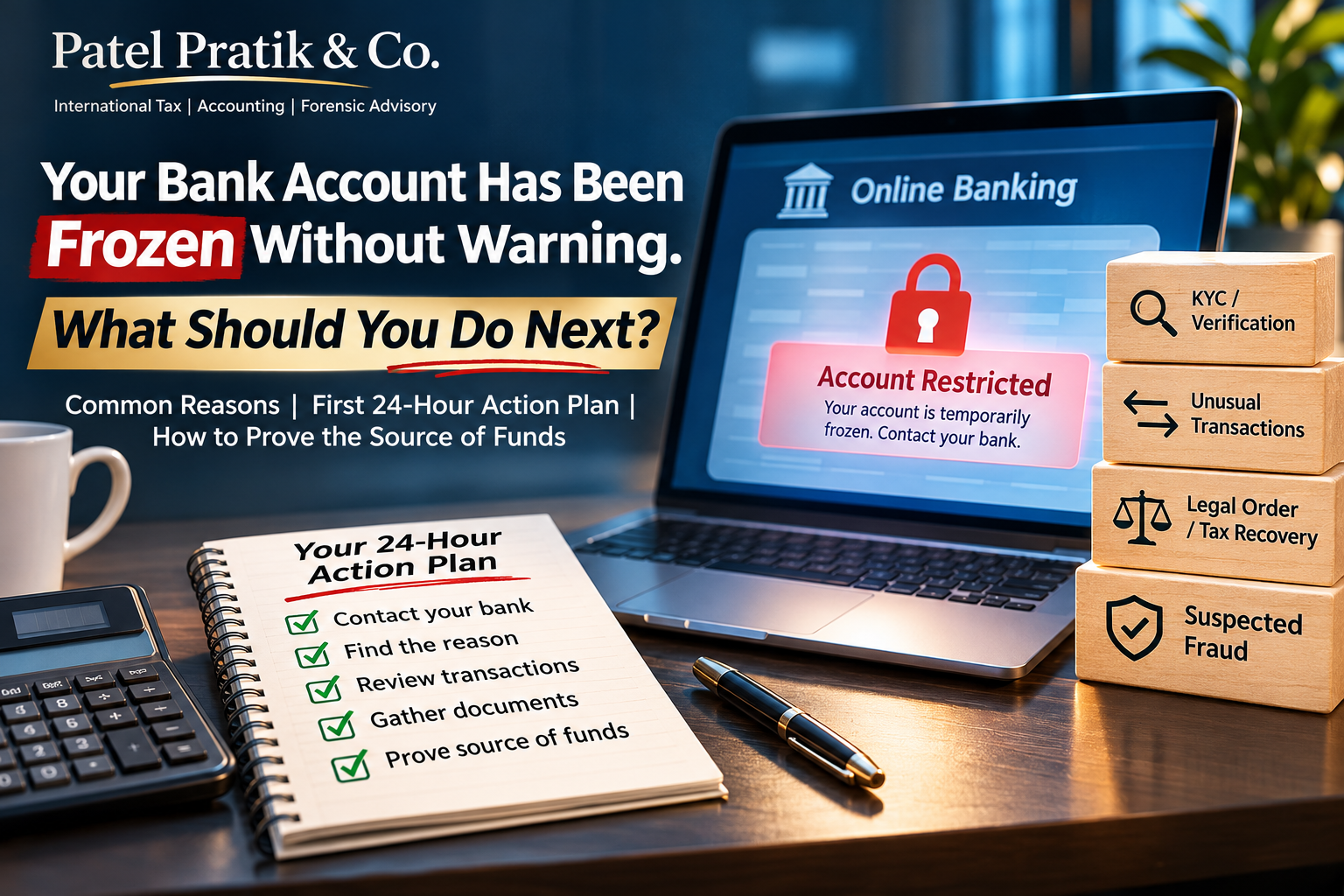
You open your banking app to make a payment. Your balance is there, but the transaction fails. You try again. Nothing happens. Then you see a message: “Your account has been temporarily restricted.”
Imagine having £25,000 in your account but suddenly being unable to use even £100.
Your rent is due. Business suppliers are waiting. You have bills to pay. And the bank hasn’t clearly explained what’s happening.
The first question that comes to mind is simple:
“It’s my money. Why can’t I access it?”
A frozen bank account can be frightening, but it doesn’t automatically mean you’ve done anything wrong.
Banks may restrict accounts because of unusual transactions, incomplete identity checks, suspected fraud or legal instructions. Sometimes, a genuine business payment triggers questions simply because the bank doesn’t have enough information about its purpose.
The important thing is knowing what to do in the first 24 hours, what documents to prepare and how to explain where your money came from.
1. Why Has Your Bank Account Been Frozen?
Banks have legal and regulatory responsibilities to monitor financial transactions, identify potential fraud and carry out customer due diligence.
An account restriction can happen for several reasons.
| Possible Reason | What It Means | What May Help |
|---|---|---|
| Unusual transactions | A payment differs significantly from your normal activity | Invoices, contracts and transaction records |
| KYC verification | Your bank needs updated identity or business information | Identification, address and business documents |
| Suspected fraud | A transaction may involve unauthorised or suspicious activity | Genuine transaction records and fraud reports |
| International transfers | The bank needs more information about an overseas payment | Payment confirmations, agreements and bank statements |
| Legal order | A court or authorised body has instructed the bank to restrict funds | Relevant legal documentation and professional legal advice |
| Unexplained deposits | The bank cannot establish the source or purpose of the money | Evidence showing where the money originated |
A transaction being unusual does not mean it is illegal.
For example, someone who usually receives £3,000 per month might suddenly receive £80,000 from selling a property.
That payment may be completely legitimate. However, the bank could request the sale agreement, completion statement and evidence of the transfer.
The problem is not necessarily the amount received.
The bank may simply need to understand the story behind the money.
2. Your First 24 Hours: What Should You Do?
If your bank account has been frozen, avoid making rushed decisions.
Instead, focus on these five steps.
Step 1: Contact Your Bank Immediately
Contact your bank through its official app, website, branch or verified telephone number.
Ask three important questions:
- Is the entire account frozen or only a particular transaction?
- Is the restriction connected to verification, suspected fraud or a legal instruction?
- What documents or action do you need from me?
The bank may not be able to disclose every detail, particularly during certain financial crime investigations.
Request a case or complaint reference number and keep a record of the conversation.
Important: Never share your password, PIN or one-time verification code with someone claiming they can release your account.
Step 2: Check Your Recent Transactions
Review recent incoming and outgoing payments.
Look for anything that might require an explanation, such as a large payment from a new customer, an overseas transfer, an unfamiliar deposit or several transactions processed within a short period.
You should also check whether any transaction was unauthorised.
If you notice suspected fraud, report it immediately through the bank’s official channels.
Step 3: Gather Documents Showing Where the Money Came From
This is where many people struggle.
A bank may ask you to establish your source of funds.
In simple words, it wants to know:
“Where did this money originally come from, and why was it paid to you?”
The answer should be supported by genuine financial records.
For example, if the money came from consulting services, you might provide a signed client agreement, invoice and bank statement.
If it came from selling property, you might need the sale agreement and settlement records.
Step 4: Protect Your Essential Payments
Check whether the restriction will affect rent, loan repayments, salaries, supplier payments or other essential obligations.
Inform relevant parties promptly where necessary, without disclosing unnecessary personal banking information.
Ask the bank whether any access to essential funds is permitted.
However, if the account is subject to a legal restraint, the bank may not be authorised to release funds without further approval.
Step 5: Keep Everything in Writing
Record the date of the restriction, your conversations with the bank, requested documents, submission confirmations and complaint references.
If the issue remains unresolved, these records may become important during the bank’s complaint process or any later regulatory review.
The first 24 hours are about understanding the problem and getting your evidence organised—not expecting an automatic 24-hour resolution.
3. How Do You Prove the Source of Your Funds?
Imagine a bank asking you to explain a £60,000 payment.
Simply saying, “It’s my business income,” may not be enough.
The bank may want to see how that money was earned, which transaction generated it and how it reached your account.
This is known as establishing the source of funds.
It is also different from source of wealth, which concerns how you built your overall financial position.
Which Documents Can Establish Source of Funds?
| Source of Money | Documents That May Support Your Explanation |
|---|---|
| Employment income | Employment contract, payslips and bank statements |
| Freelance income | Client invoices, service agreements and payment records |
| Business sales | Sales invoices, accounting records and business bank statements |
| Property sale | Sale agreement, completion statement and transfer confirmation |
| Inheritance | Probate or estate documents and distribution records |
| Family gift | Genuine gift declaration and relevant supporting transfer evidence |
| Loan | Signed loan agreement and bank disbursement records |
| Investment proceeds | Broker statement, sale confirmation and bank credit |
| Transfer from your own account | Statements showing the original account and transfer |
The exact requirements will depend on the bank, jurisdiction and circumstances.
Providing documents does not guarantee that the bank will release the funds, but a clear and consistent record can help establish what happened.
4. A Practical Example: Your Bank Freezes a £50,000 International Payment
Consider a UK-based business consultant who completes a project for an overseas client.
The client pays £50,000 into the consultant’s business account.
A short time later, the bank restricts the account and requests information about the payment.
The consultant has a legitimate explanation.
But how should the evidence be presented?
Transaction Reconciliation
| Description | Amount |
|---|---|
| Contracted consulting fee | £50,000 |
| Invoice issued to the client | £50,000 |
| Payment received in bank | £50,000 |
| Unexplained difference | £0 |
The consultant can now prepare the supporting documents:
- Signed consulting agreement.
- Invoice issued to the overseas client.
- Evidence that the services were delivered.
- Payment confirmation from the client.
- Bank statement showing the receipt.
These documents help connect the commercial arrangement to the payment.
But there is something important to understand.
A matching invoice and bank receipt do not, by themselves, prove that a payment is legitimate.
The bank may still need to understand the customer’s identity, the nature of the business relationship or other transaction details.
That is why a complete and accurate explanation matters more than simply presenting matching figures.
5. What If the Money Passed Through Multiple Accounts?
This can make source-of-funds verification more complicated.
For example, imagine the following payment journey:
Overseas Client → Payment Processor → Business Bank Account
The client pays £20,000 through a payment platform.
The payment processor deducts £300 in fees before transferring the money to the business account.
The bank receives only £19,700.
Payment Reconciliation
| Transaction | Amount |
|---|---|
| Original client payment | £20,000 |
| Less: Payment processing fees | (£300) |
| Expected bank settlement | £19,700 |
| Actual bank receipt | £19,700 |
| Reconciliation difference | £0 |
In this illustrative case, the business should retain the customer invoice, payment processor report, fee statement and bank records.
The documentation explains why the amount received differs from the original payment.
For more complex transfers, additional records may be needed to trace the funds through each account.
The objective is to establish a reliable financial trail—not simply to explain the final deposit.
6. How Long Does It Take to Unfreeze a Bank Account?
There is no single worldwide deadline for every account freeze.
The answer depends on the reason behind the restriction.
A simple identity verification issue may be resolved relatively quickly after the bank receives satisfactory documents.
A complex fraud investigation or a court-ordered restriction may take much longer.
Different countries also have different regulatory and complaint procedures.
| Country | Where You Can Raise a Complaint |
|---|---|
| United Kingdom | The bank’s complaints team, followed by the Financial Ombudsman Service where eligible |
| United States | The bank’s complaint process, the Consumer Financial Protection Bureau or the relevant banking regulator, depending on the issue |
| India | The bank’s grievance process, followed by the RBI Ombudsman where the complaint is eligible |
In India, the Reserve Bank – Integrated Ombudsman Scheme, 2026 provides a framework for eligible banking service complaints. Customers generally need to complain to the bank first and meet the applicable response or waiting conditions.
In the UK, the Financial Ombudsman Service can consider eligible complaints involving frozen accounts and blocked payments.
However, an ombudsman complaint will not automatically override a valid court order or other lawful restriction.
If a legal authority has imposed the freeze, obtaining appropriate legal advice may be necessary.
7. Five Mistakes That Can Make the Situation Worse
When access to money is restricted, people naturally want an immediate solution.
Unfortunately, some actions can create further problems.
Mistake 1: Submitting incomplete or misleading documents
Provide genuine documents and explain any missing information. Never create a false invoice, contract or transaction record.
Mistake 2: Ignoring the bank’s questions
Failure to provide relevant information may delay the review or prevent the bank from completing its checks.
Mistake 3: Assuming every freeze is a money laundering investigation
Account restrictions can arise for many different reasons. Understand the actual issue before reaching conclusions.
Mistake 4: Trying to bypass the restriction
Do not move funds or use alternative arrangements to evade a lawful freeze or conceal financial activity.
Mistake 5: Failing to maintain a proper financial trail
A business might have legitimate income but still struggle to explain transactions if accounting records, invoices and bank statements do not reconcile.
Good financial records are not only useful for preparing accounts and tax returns.
They can also be important when a bank asks questions about your money.
8. When Can a Forensic Accountant Help?
Some banking issues can be resolved simply by providing updated identification or an invoice.
Others require a more detailed investigation of financial records.
For example, imagine a business receiving payments from clients in several countries, through different bank accounts and payment processors.
The transactions might be legitimate, but the records may be incomplete or difficult to follow.
A forensic accountant can assist by:
- Tracing payments through multiple accounts.
- Reconciling bank transactions against accounting records.
- Identifying unexplained differences.
- Reviewing invoices, contracts and supporting documents.
- Preparing a structured source-of-funds reconciliation.
- Highlighting financial records that require further explanation.
This work can help produce a clearer, evidence-based financial picture.
However, a forensic accountant cannot guarantee that a bank will release an account, and legal restrictions may require advice from a qualified lawyer.
9. Frequently Asked Questions
Can a bank freeze my account without warning?
Yes, in certain circumstances. Banks may restrict accounts without advance notice because of suspected fraud, regulatory obligations or legal instructions. The rules depend on the country and circumstances.
Does a frozen bank account mean my money is illegal?
No. An account restriction does not automatically establish wrongdoing. It may be related to customer verification, fraud prevention or a legal process.
Can I withdraw money if my account is frozen?
It depends on the restriction. Some freezes affect only a particular transaction, while others prevent withdrawals from the entire account.
Can tax returns prove my source of funds?
Tax returns may help support your explanation, but they are not always sufficient. A bank may need transaction-specific documents such as invoices, contracts, sale agreements and bank records.
Can I open another bank account while my existing account is frozen?
Depending on your circumstances and the bank’s requirements, you may be able to apply for another account. However, you must not use another account to bypass a lawful restriction or conceal relevant information.
Will the bank automatically unfreeze my account after I submit documents?
Not necessarily. The bank must assess the information and comply with any applicable legal or regulatory requirements.
Final Thoughts: Your Money Needs a Clear Financial Trail
A frozen bank account can disrupt your personal finances or business operations within hours.
But the best response is not panic.
First, establish why the restriction occurred. Second, identify the transactions involved. Third, gather genuine supporting evidence showing where the funds came from.
If your money has moved across different countries, companies or payment platforms, make sure the records connect each stage of the transaction.
The easier it is to understand the financial trail, the easier it may be to answer legitimate questions about the money.
And remember: a frozen account does not automatically mean wrongdoing. It means the reason for the restriction needs to be understood and addressed.
Need Help Tracing Transactions or Establishing Source of Funds?
At Patel Pratik & Co., we assist with forensic accounting, financial reconciliations and transaction reviews for businesses and individuals dealing with complex financial records.
Whether you need to reconcile international payments, investigate unexplained differences or organise source-of-funds documentation, a structured financial review can help establish a clearer picture.